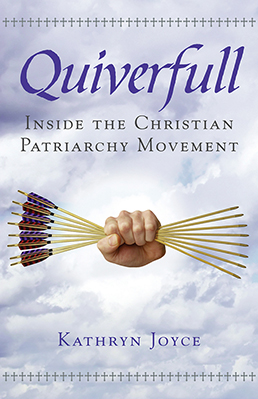
Quiverfull: Inside the Christian Patriarchy Movement is out now
"Kathryn Joyce gives us a first-ever glimpse into the Christian patriarchy movement, and her riveting reporting makes it all the scarier. If you’ve been feeling complacent about women’s status—read this book!" —Barbara Ehrenreich, author of Nickel and Dimed and This Land is Their LandNew story at Slate:
Angie Jackson, the Florida mother now known as the abortion tweeter, isn’t the first woman to try to demystify abortion by talking about her story publicly. Since Romper Room personality Sherri Chessen got a very public abortion in 1962 after taking thalidomide, women have tried to erase the lingering shame of abortion by publicizing their own. Author Jennifer Baumgardner recently started the “I had an abortion” T-shirt project. A forthcoming Web site, ShareWithThree.org, urges women to “come out” to three friends about their abortions.
Yahoo! Buzz FacebookMySpace Mixx Digg Reddit del.icio.us Furl Ma.gnolia SphereStumbleUponCLOSEJackson’s innovation was to use Twitter and YouTube to detail her experience with the drug RU-486 and thus expose her personal life to assault and dissection. One hundred twenty-nine thousand viewers watched Jackson’s first YouTube video about her abortion and left nearly 10,000 comments. Anti-abortion blogger Jill Stanek devoted a 10-part blog series to analyzing Jackson’s tweets and picking apart the side effects she suffered. Some commenters have questioned whether Jackson’s claim that a pregnancy would be very risky for her is valid. Others have been viciously critical, calling Jackson a murderer or making death threats against her family, including one commenter who said he hoped Jackson’s 4-year-old son would be ripped limb from limb.
Jackson, whose special-needs son was born after a grueling 98-hour delivery, says her motivation is to counter the stories of regret the anti-abortion movement has cultivated in recent years. As the controversy continues, one of the most interesting—and motivating—parts of her narrative has been largely overlooked: her intimate connection with a religious movement—one she now calls a cult—that glorified fertility and childbirth and demonized medical intervention even when mothers’ labors were going very wrong.
New review at Harvard Divinity Bulletin:
Given the enmity that recent works on evolution and God have fostered, pitting science and rationalism against spirit and faith—with “new atheist” celebrities casting believers as Scopes-era fools, and creationist culture warriors declaring natural selection the foundation of the Holocaust—Robert Wright’s The Evolution of God stands on remarkably conciliatory ground. There’s not only room enough for both, Wright argues, but they’re inextricably bound together in the story of human progress toward broader morality (however improbable that might seem today).
Wright’s argument, based on an exhaustive overview of religion’s path from “primordial faith” to universalistic monotheisms, isn’t for die-hard partisans of either camp. Wright, who has written extensively about science and religion, takes natural selection and evolution as bedrock fact and wastes no ink worrying culture-war causes. But he also makes a methodical and compelling argument for continuing to see scripture, or rather scriptures, as revelation of a sort. The holy books of the world and their prewritten forerunners, Wright argues, may not contain, within their endlessly revised and reordered stories, the revealed word of a God who created human morality. Rather, taken together, they unveil the slow and halting progress of humanity toward greater goodness and the constantly evolving identity of gods who don’t cause, but reflect, this transformation.
If, for believers, the bad news in Wright’s book is that man created God, the good news is that God’s growth over the millennia mirrors our species’ overall trend toward self-improvement. Wright argues against what he calls the “romantic view of religion as fallen—having been born pure only to be corrupted later,” and says that, from the beginning, religion has been the conflict-cultivating force it remains today. But if religion, for Wright, hasn’t been a solely positive force, nudging society toward selflessness and compassion, neither does he see it exclusively as a tool of social control wielded by the powerful. Rather, religious evolution has been a wobbling tale of slow progress toward cooperation, wherein “interfaith harmony [emerges] from enlightened self-interest.”
New Q&A with Gayle Haggard at Religion Dispatches:
Before Ted Haggard’s 2006 fall from grace—the result of a scandal involving drug use and a male prostitute—he and his wife Gayle coauthored a breezy, heavily illustrated marriage guide: From This Day Forward: Making Your Vows Last a Lifetime. Post-scandal, the book seemed to epitomize the unrealistic demands the Christian right puts on women: that a “wife loves her husband with unflinching devotion,” seeks to please him, love him, and above all help him, since, as the book warns, men often have affairs with coworkers because they “are drawn to the women who help them do their task.”
The warning applied little to Gayle, who had dropped out of Oral Roberts University to “support a man of God” like Ted, and worked at his side for years as a nationally-recognized evangelical women’s figure, running New Life’s women’s ministry teaching students to be better wives. Yet when Ted fell, fellow megachurch pastor Mark Driscoll took the opportunity to crudely chastiseGayle Haggard by insinuation, writing that pastors’ wives too often “let themselves go,” confident that their pastor husband is trapped by vocation into fidelity.
Although Driscoll’s remarks were widely condemned, they merely highlighted a commonly held view that Ted’s actions became Gayle’s shared sin, and revealed the certainty from the outset that all eyes would be on Gayle as the couple responded to the crisis. Gayle announced as much in a goodbye letter that was read to the congregation in her absence, providing a parting lesson to the women of the church: this was no rupture in their marriage, but a continuation of her life’s role. “My test has begun,” Gayle wrote, “watch me. I will try to prove myself faithful.”
In time, however, once the Haggards fell into an unglamorous obscurity in the suburban southwest, and after Gayle stood by her man through betrayal, financial uncertainty and the disdain of most of her community, they seemed to stop watching her. Until now.
New story at Religion Dispatches:
On February 4, Secretary of State Hillary Clinton was the surprise keynote speaker for the 58th annual National Prayer Breakfast. The Breakfast is the one public event organized by the secretive Washington network, the Family, a group of elite fundamentalists who minister to DC’s powerful and wealthy who are seen as the divinely “elect,” chosen for leadership by God. With the Family in the news this past year due to the string of sex scandals at its “C Street” house for members of Congress—and later for the role it seems to have played in shaping the draconian anti-gay law introduced in Uganda last year—the speech by Clinton, sandwiched between Family head Doug Coe’s introduction and the traditional presidential address by Barack Obama, was an interesting coda to her strange status as a longtime “friend” of the Family.
Although much of the media coverage focused on Clinton’s and then President Obama’s condemnations of the anti-gay bill (leading religion scholar Mark Silk to suggest that Clinton’s role was damage control as the Family struggles to make the Uganda bill “go away”) Clinton’s speech also underscored the Family’s influence in pushing her stance on reproductive freedom rightward.
In her address, Clinton sentimentally recalled meeting Mother Teresa at the 1994 National Prayer Breakfast. Mother Teresa had used her platform as guest speaker to chastise the Clintons (standing right beside her, smiles stretched to the breaking point) for their nominal support of abortion rights. “Any country that accepts abortion is not teaching its people to love, but to use any violence to get what they want,” Mother Teresa said, and went on to suggest adoption be promoted as an alternative to abortion. “Please don’t kill the child. I want the child. Please give me the child.”
Mother Teresa’s pro-life fans swooned, with many giving the nun a standing ovation. The Clintons remained seated, yet both—particularly the ever-politic Hillary—understood how behind-the-scenes power politics work within the Christian Right, and responded to the rebuke by finding “common ground” with the nun.
New story up at The Daily Beast:
For the past week, the news from Haiti has been dominated by the story of 10 American evangelicals from Idaho who were caught at the border of the Dominican Republic attempting to take 33 Haitian children, many with living parents, out of the country without documentation. The Americans, missionaries with the recently created New Life Children’s Refuge, were arrested and charged with kidnapping and criminal conspiracy—a reprieve from the child trafficking charges they may have faced.
The details that emerged about the group’s plans and leader, Laura Silsby, were unsavory. Although Silsby, the legally embattled CEO of a personal shopping business, claimed that the group never intended to put the children up for adoption, an itinerary for New Life’s mission, published by an affiliated Southern Baptist church, bluntly described a plan to “gather 100 orphans from the streets and collapsed orphanages” onto a bus, then take them to a hotel in the Dominican Republic. There, New Life hoped to build permanent orphanage facilities, including a beachfront restaurant and “seaside villas” for prospective adoptive parents—amenities that underscore their understanding of local adoption residency requirements, even as they claimed ignorance of Haitian law. Additional planning and fundraising documents described the group’s goal to “equip each child” with the opportunity “for adoption into a loving Christian family,” and help them “find new life in Christ.”
After the arrests, Silsby and supporters explained that they’d been called by God to help orphans in Haiti, that they were “acting not only in faith but God’s faith.”
The news of an adoption organization driven by missionary zeal surprised many, but it shouldn’t. Although New Life’s illegal actions have been condemned by other religious adoption agencies, their sense of calling fits into a growing movement of American evangelical churches embracing a new orphan theology that urges Christians to see adoption and “orphan-care” as an integral part of their faith—and a means of spreading the gospel.
“You hear these legends of coat hanger abortions,” a 26-year-old former Marine sergeant told me recently, “but there are no coat hangers in Iraq. I looked.” Amy (who prefers not to use her real name) was stationed in Fallujah as a military journalist two years ago when she discovered she was pregnant. As a female Marine, a distinct minority in the branch, Amy was fearful of going to her chain of command to explain her situation.
For military women, who lack all rights to medical privacy, facing an unplanned pregnancy is a daunting obstacle. Thanks to anti-abortion forces in Congress, military hospitals are banned from providing abortion services, except in cases of life endangerment, rape or incest (and for the latter two, only if the patient pays for the service herself). Amy says her options were “like being given a choice between swimming in a pond full of crocodiles or piranhas.”
New Religion Dispatches Q&A on Kapya Kaoma’s Report on the Mutually Beneficial Relationship Between US Evangelicals and African Antigay Clergy
A new report released November 18 details the role that US-based renewal church movements have played in mobilizing homophobic sentiment in at least three African countries. “Globalizing the Culture Wars: U.S. Conservatives, African Churches & Homophobia,” written by Rev. Kapya Kaoma for the progressive think tank Political Research Associates, was the result of a yearlong investigation into the relationship between conservative clergy on two continents, which has hastened divisions within denominations and has “restrict[ed] the human rights of lesbian, gay, bisexual and transgender (LGBT) people.”
Renewal groups and their neoconservative ally, the Institute on Religion and Democracy, have long sought to conservatize or split mainline American churches—frequently over gender or sexuality issues—and liberal scholars have traced many of the mainline schisms that have dominated headlines over the past several years to groundwork laid by the IRD and others.*
Increasingly, though, renewal movements have begun looking abroad for allies. Focusing on three mainline denominations under assault by these renewal movements (the Episcopal Church, the United Methodist Church, and the Presbyterian Church USA) in three African countries (Uganda, Nigeria, and Kenya), Kaoma has documented a clear trend of the US Christian right exporting its battles over social and sexuality issues to Africa. There, churches have been pressured to sever ties with mainline funders in exchange for conservative support, and have become recipients of a more fiercely anti-gay message than the US Christian right delivers at home.
New article at Double X:
At the end of October, National Domestic Violence Awareness Month, members of the men’s movement group RADAR (Respecting Accuracy in Domestic Abuse Reporting) gathered on the steps of Congress to lobby against what they say are the suppressed truths about domestic violence: that false allegations are rampant, that a feminist-run court system fraudulently separates innocent fathers from children, that battered women’s shelters are running a racket that funnels federal dollars to feminists, that domestic-violence laws give cover to cagey mail-order brides seeking Green Cards, and finally, that men are victims of an unrecognized epidemic of violence at the hands of abusive wives.
“It’s now reached the point,” reads a statement from RADAR, “that domestic violence laws represent the largest roll-back in Americans’ civil rights since the Jim Crow era!”
RADAR’s rhetoric may seem overblown, but lately the group and its many partners have been racking up very real accomplishments. In 2008, the organization claimed to have blocked passage of four federal domestic-violence bills, among them an expansion of the Violence Against Women Act (VAWA) to international scope and a grant to support lawyers in pro bono domestic-violence work. Members of this coalition have gotten themselves onto drafting committees for VAWA’s 2011 reauthorization. Local groups in West Virginia and California have also had important successes, criminalizing false claims of domestic violence in custody cases, and winning rulings that women-only shelters are discriminatory.
New at The Nation
Christian agencies lavish support services on pregnant women–if they give up their babies.
Carol Jordan, a 32-year-old pharmacy technician, was living in Greenville, South Carolina, in 1999 when she became pregnant. She’d already decided against abortion, but she was struggling financially and her boyfriend was unsupportive. Looking through the Yellow Pages for help, she spotted an ad under “crisis pregnancies” for Bethany Christian Services. Within hours of calling, Jordan (who asked to be identified with a pseudonym) was invited to Bethany’s local office to discuss free housing and medical care.
Bethany, it turned out, did not simply specialize in counseling pregnant women. It is the nation’s largest adoption agency, with more than eighty-five offices in fifteen countries.
When Jordan arrived, a counselor began asking whether she’d considered adoption and talking about the poverty rates of single mothers. Over five counseling sessions, she convinced Jordan that adoption was a win-win situation: Jordan wouldn’t “have death on her hands,” her bills would be paid and the baby would go to a family of her choosing in an open adoption. She suggested Jordan move into one of Bethany’s “shepherding family” homes, away from the influence of family and friends.
Crisis pregnancy centers (CPCs), the nonprofit pregnancy-testing facilities set up by antiabortion groups to dissuade women from having abortions, have become fixtures of the antiabortion landscape, buttressed by an estimated $60 million in federal abstinence and marriage-promotion funds. The National Abortion Federation estimates that as many as 4,000 CPCs operate in the United States, often using deceptive tactics like posing as abortion providers and showing women graphic antiabortion films. While there is growing awareness of how CPCs hinder abortion access, the centers have a broader agenda that is less well known: they seek not only to induce women to “choose life” but to choose adoption, either by offering adoption services themselves, as in Bethany’s case, or by referring women to Christian adoption agencies. Far more than other adoption agencies, conservative Christian agencies demonstrate a pattern and history of coercing women to relinquish their children.
My Womb for His Purposes: The Perils of Unassisted Childbirth in the Quiverfull Movement
New piece up at Religion Dispatches:
In the last week of June, two different circles of blogs invested in the Quiverfull movement—both as critics and supporters of the pro-natalist, patriarchal, conservative Christian lifestyle—focused on the sad news of the death of one Quiverfull mother’s child shortly after birth. The woman was Carri Chmielewski, author of the now-private blog “Carri Me Away,” where she described her Quiverfull lifestyle, eschewing contraception, having as many children as God gave her, submitting to her husband’s leadership, and, in a related conviction common among Quiverfull adherents, her plans to deliver her children through unassisted childbirth—a home birth with no doctors, nurses, or midwives to help her and her husband through labor and aftercare.
For weeks, Chmielewski’s plans drew the scrutiny and concern of Quiverfull critics, such as the commenters on the wryly-named ”Free Jinger” forum, a discussion board dedicated to “freeing” Jinger Duggar, one of the daughters of the Quiverfull Duggar family featured on reality TV show 18 Kids and Counting. Commenters there and elsewhere followed news of Chmielewski’s pregnancy, at first with light snark directed at this exemplar of Quiverfull conviction, and then growing concern as Chmielewski described mounting complications: she reportedly measured much larger than expected for a normal pregnancy and discussed her own doubts and misgivings about going through with the unassisted birth.